System 01
Why onboard AI compute matters
Onboard processing reduces dependence on a continuous high-bandwidth link and lets mission software interpret sensor data close to where it is generated.
Jetson Orin Nano drone AI
Bring AI inference, sensor processing, mission decisions, and MAVLink communication onboard the UAV with a dedicated companion computer.
Mission capability
Aeroniti integrates Jetson Orin Nano onboard computers with drone sensors, AI models, MAVLink telemetry, Pixhawk flight controllers, and autonomous mission logic.
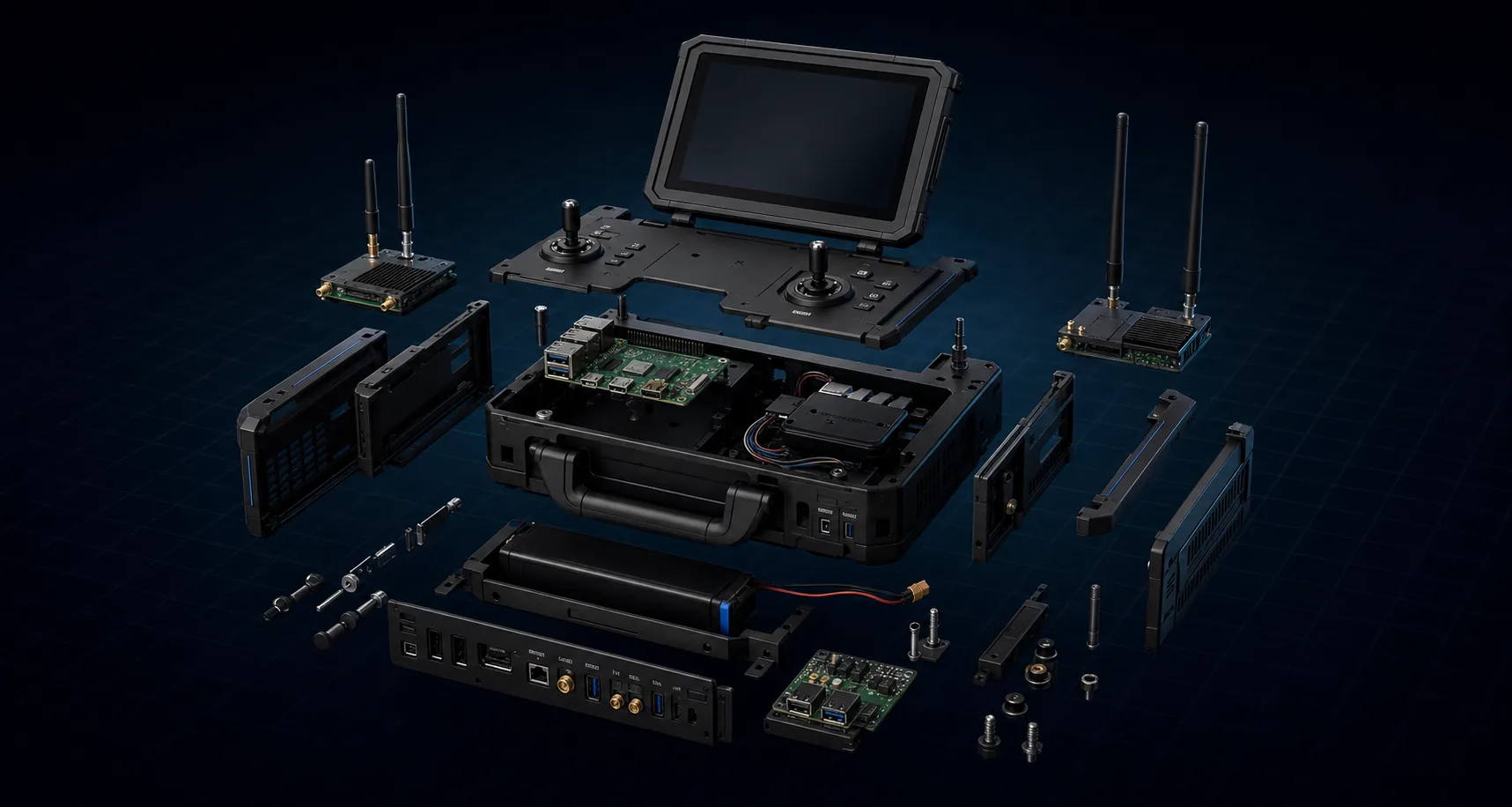
How the system works
Each layer is configured around the aircraft, operating environment, sensor stack, safety requirements, and level of human supervision.
Onboard processing reduces dependence on a continuous high-bandwidth link and lets mission software interpret sensor data close to where it is generated.
Jetson Orin Nano provides GPU-accelerated compute for perception, sensor processing, model inference, mission logic, and companion-computer communication within an integrated UAV.
A configured compute stack can ingest complementary visual, depth, thermal, and ranging data, subject to interface compatibility and mission requirements.
Aeroniti can integrate YOLO-family or custom models for relevant detection tasks, then connect inference output to evidence capture, alerts, or bounded mission actions.
The Jetson companion computer exchanges telemetry and command intent through MAVLink while Pixhawk running ArduPilot retains safety-critical flight control.
Operators retain mission visibility and intervention controls. The onboard computer adds intelligence without replacing geofence, failsafes, return-to-launch, or pilot authority.
Frequently asked questions
Practical answers for teams assessing an Aeroniti mission configuration.
It acts as a companion computer for AI inference, sensor processing, mission decisions, telemetry handling, and communication with the autopilot.
Yes. A companion-computer integration commonly uses MAVLink over an appropriate serial, USB, or network interface.
Yes. Model selection and performance depend on the chosen architecture, optimization, input resolution, frame rate, thermal design, and mission requirements.
Depending on interfaces and configuration, inputs can include RGB, depth, thermal, LiDAR, and other mission-specific sensors.
No. The Jetson provides the intelligence layer, while Pixhawk and ArduPilot provide flight control and safety behavior.
Request demo
Share the mission, aircraft, operating environment, sensors, payload, safety constraints, and expected outcome. Aeroniti can define a focused integration and field-validation path.