System 01
Pixhawk as the flight safety layer
Pixhawk handles the time-critical flight-control loop, including stabilization, attitude estimation, motor output, and supported vehicle control behavior.
Pixhawk ArduPilot drone integration
Integrate flight control, onboard AI, sensors, telemetry, payloads, mission software, and operator safety into one testable UAV architecture.
Mission capability
Aeroniti builds Pixhawk and ArduPilot drone integrations with telemetry, mission planning, onboard AI, MAVLink commands, sensors, failsafes, and operator supervision.
How the system works
Each layer is configured around the aircraft, operating environment, sensor stack, safety requirements, and level of human supervision.
Pixhawk handles the time-critical flight-control loop, including stabilization, attitude estimation, motor output, and supported vehicle control behavior.
ArduPilot provides configurable flight modes and safety features such as return-to-launch, geofence, radio-loss actions, battery failsafes, and pilot override.
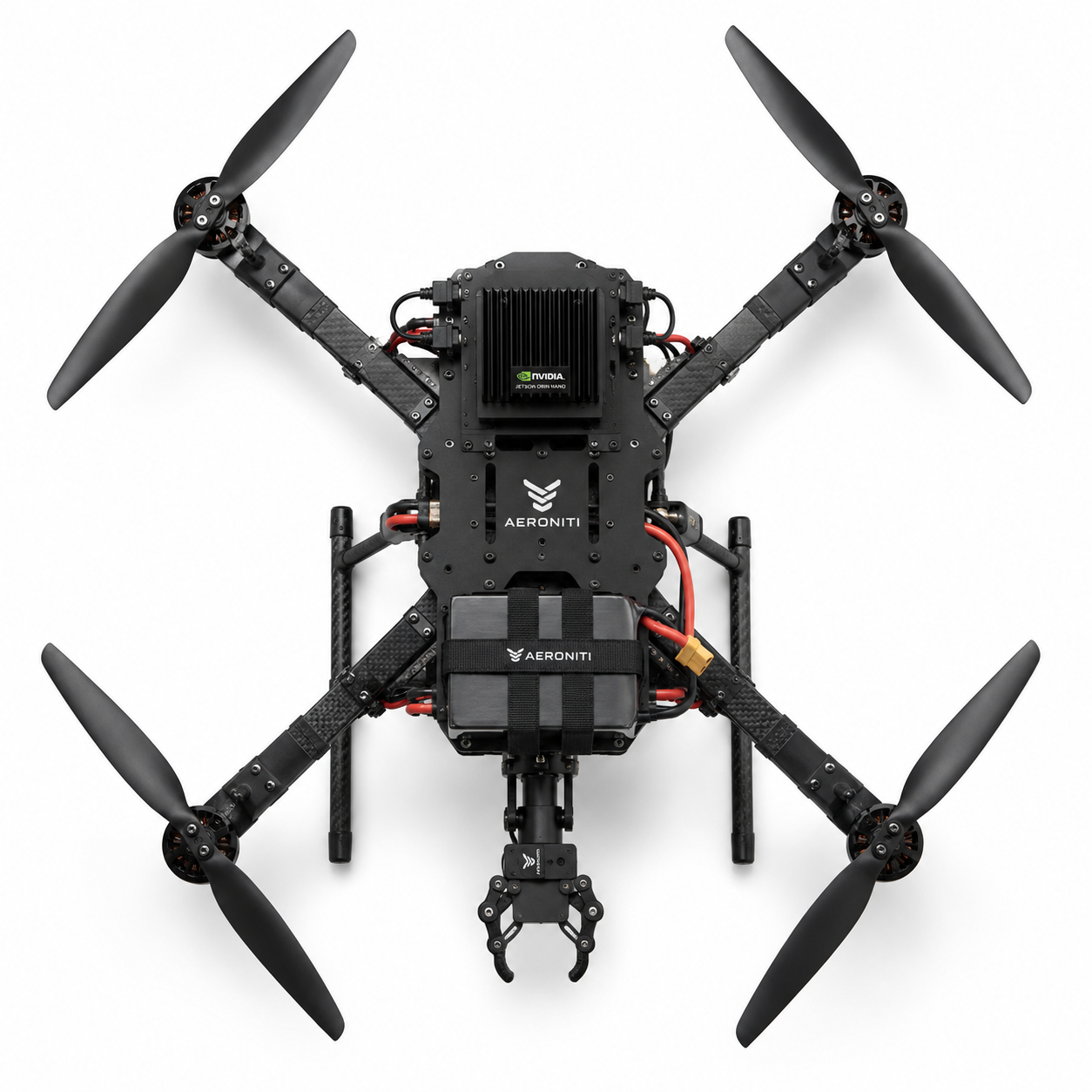
A separate companion computer interprets sensors and mission state, then requests actions without taking over the motor-control responsibilities of the autopilot.
MAVLink carries mission items, telemetry, status, and supported commands between ground control, the companion computer, and the flight controller.
Telemetry radio and network links connect the aircraft to Aeroniti Command One for planning, monitoring, live information, and operator intervention.
Aeroniti can integrate cameras, depth sensors, thermal sensors, LiDAR, grippers, telemetry, video links, and mission payloads around the selected airframe and power budget.
Frequently asked questions
Practical answers for teams assessing an Aeroniti mission configuration.
It is the process of configuring the flight controller, firmware, sensors, telemetry, mission software, safety behavior, and optional companion computer as one aircraft system.
MAVLink carries telemetry, mission information, status, and supported command messages between the flight controller, onboard computer, and ground station.
Yes. AI can run on a companion computer and request actions while ArduPilot remains the flight-control and safety layer.
Configurations may include battery, communication-loss, geofence, return-to-launch, landing, and pilot-override behavior based on the platform and operating plan.
Aeroniti can assess compatible existing airframes and components, then define the required flight-controller, compute, sensor, communication, and payload integration work.
Request demo
Share the mission, aircraft, operating environment, sensors, payload, safety constraints, and expected outcome. Aeroniti can define a focused integration and field-validation path.