Drone Gripper · Payload Automation · Delivery Drone
Drone Gripper Pick and Drop System
By Aeroniti Engineering · Published 2026-07-19 · Updated 2026-07-19
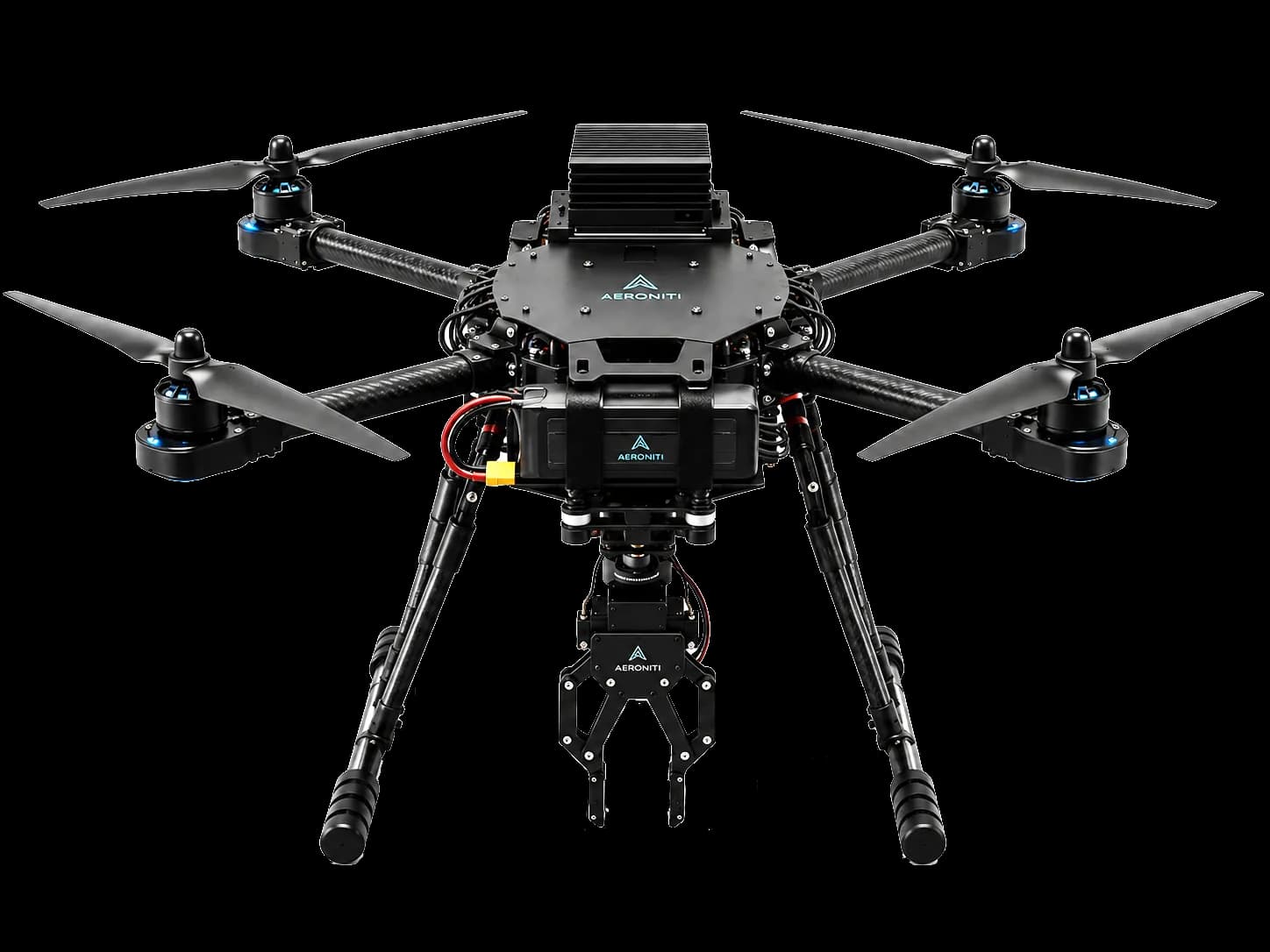
A drone gripper system connects mechanical design, actuation, sensing, onboard compute, flight control, and mission logic. Opening and closing a mechanism is the simplest part. Reliable pickup requires the aircraft to find a suitable target, estimate relative position, approach without unstable ground effect, align the gripper, confirm engagement, accommodate a new center of gravity, and retain a safe release or abort path.
Payload interaction changes the aircraft. Mass, drag, pendulum behavior, propulsion margin, battery demand, landing clearance, and control response can differ after pickup. A mission-grade system therefore treats payload state as part of the vehicle configuration and exposes it to both flight logic and the operator.
Architecture flow
The following simplified flow shows where information is interpreted and where flight-safe execution remains separated. Actual interfaces, rates, redundancy, and authority depend on the aircraft and mission.
What drone gripper system means in practice
A drone gripper system is a supervised payload-handling subsystem that coordinates perception, relative positioning, approach, actuation, load confirmation, transport, and release. Its operating envelope is defined by the aircraft, gripper geometry, payload properties, environment, and tested safety margins.
01 — Mechanical gripper
provides suitable geometry, friction, retention, compliance, and release behavior For drone gripper system, verify this against the aircraft, mission objective, compute budget, sensors, communication link, and flight-safety boundary.
02 — Actuator and driver
convert commands into controlled motion with current, position, force, or limit feedback For drone gripper system, verify this against the aircraft, mission objective, compute budget, sensors, communication link, and flight-safety boundary.
03 — Depth or vision sensing
estimates target location, approach distance, orientation, and engagement context For drone gripper system, verify this against the aircraft, mission objective, compute budget, sensors, communication link, and flight-safety boundary.
04 — Mission controller
sequences search, approach, grasp, confirm, lift, transport, release, and abort states For drone gripper system, verify this against the aircraft, mission objective, compute budget, sensors, communication link, and flight-safety boundary.
Architecture and component responsibilities
A useful architecture assigns each component a narrow responsibility and makes every authority transition visible. For drone gripper system, system quality depends less on one device than on how data, commands, acknowledgements, and failures move between components.
01 — Payload command
gripper actions need interlocks, acknowledgement, timeout, and a known state after restart For drone gripper system, verify this against message ownership, update rate, latency, stale-data handling, command acknowledgement, and operator authority.
02 — Target estimate
coordinates require a clear frame, confidence, timestamp, and transform to gripper geometry For drone gripper system, verify this against message ownership, update rate, latency, stale-data handling, command acknowledgement, and operator authority.
03 — Flight request
close-range approach needs constrained speed, acceleration, altitude, and pilot override For drone gripper system, verify this against message ownership, update rate, latency, stale-data handling, command acknowledgement, and operator authority.
04 — Load state
the autopilot and operator should know whether payload is absent, uncertain, secured, or released For drone gripper system, verify this against message ownership, update rate, latency, stale-data handling, command acknowledgement, and operator authority.
End-to-end operating workflow
The workflow should describe the system from mission preparation through execution and recovery. The sequence below is deliberately operational: it connects software behavior with checks that an engineering team and an operator can observe.
01 — Detect and qualify
confirm a compatible target and authorized pickup zone before approach For drone gripper system, verify this against mission state, pre-flight readiness, environmental conditions, flight mode, telemetry freshness, and the defined recovery path.
02 — Align and descend
use repeated fresh measurements with conservative speed and an abort corridor For drone gripper system, verify this against mission state, pre-flight readiness, environmental conditions, flight mode, telemetry freshness, and the defined recovery path.
03 — Grasp and verify
actuate the gripper and confirm engagement without relying on command completion alone For drone gripper system, verify this against mission state, pre-flight readiness, environmental conditions, flight mode, telemetry freshness, and the defined recovery path.
04 — Lift, transport, and release
reassess vehicle response and confirm release before departing the drop zone For drone gripper system, verify this against mission state, pre-flight readiness, environmental conditions, flight mode, telemetry freshness, and the defined recovery path.
Engineering design considerations
A technically credible system is built around constraints rather than ideal demonstrations. These considerations shape hardware selection, software boundaries, test coverage, and the conditions under which the capability should or should not be enabled.
01 — Mass properties
calculate payload limit, center-of-gravity shift, inertia, rotor clearance, and landing clearance For drone gripper system, verify this against power, mass, thermal limits, vibration, electromagnetic compatibility, timing, maintainability, and safe degradation.
02 — Retention
consider vibration, acceleration, attitude, wind, payload shape, and loss of actuator power For drone gripper system, verify this against power, mass, thermal limits, vibration, electromagnetic compatibility, timing, maintainability, and safe degradation.
03 — Ground interaction
downwash, dust, vegetation, people, obstacles, and ground effect change close-range behavior For drone gripper system, verify this against power, mass, thermal limits, vibration, electromagnetic compatibility, timing, maintainability, and safe degradation.
04 — Fail-safe release
decide whether power loss should hold or release based on the mission hazard For drone gripper system, verify this against power, mass, thermal limits, vibration, electromagnetic compatibility, timing, maintainability, and safe degradation.
Limitations and failure modes
No autonomy or sensing capability should be presented as certain in every environment. Identifying limitations early prevents a promising prototype from becoming an unsafe or unreliable field workflow.
01 — Target variability
shape, softness, texture, orientation, reflectivity, and accessibility affect grasp quality For drone gripper system, verify this against sensor uncertainty, occlusion, weather, range, vehicle dynamics, communications, human factors, and regulatory operating limits.
02 — Moving aircraft
position error, wind, control latency, and oscillation complicate precise contact For drone gripper system, verify this against sensor uncertainty, occlusion, weather, range, vehicle dynamics, communications, human factors, and regulatory operating limits.
03 — Unknown load
partial engagement can create a dangerous suspended or shifting payload For drone gripper system, verify this against sensor uncertainty, occlusion, weather, range, vehicle dynamics, communications, human factors, and regulatory operating limits.
04 — Regulation and site safety
carrying and releasing objects introduces operational restrictions and ground risk For drone gripper system, verify this against sensor uncertainty, occlusion, weather, range, vehicle dynamics, communications, human factors, and regulatory operating limits.
Verification before flight
Verification should progress from repeatable software tests to integrated hardware and controlled flight. Passing a nominal demonstration is only one result; the team must also test missing, delayed, contradictory, and out-of-range inputs.
01 — Mechanical cycling
test wear, retention, current, heat, limits, jams, and emergency release over repeated cycles For drone gripper system, verify this against acceptance criteria, traceable logs, repeatability, safe abort behavior, manual override, and evidence that each fallback occurs within its allowed time.
02 — Static load
verify payload and safety factors across orientation and expected acceleration For drone gripper system, verify this against acceptance criteria, traceable logs, repeatability, safe abort behavior, manual override, and evidence that each fallback occurs within its allowed time.
03 — Restrained integration
exercise perception, state machine, commands, feedback, and aborts without free flight For drone gripper system, verify this against acceptance criteria, traceable logs, repeatability, safe abort behavior, manual override, and evidence that each fallback occurs within its allowed time.
04 — Progressive pickup
start with soft light targets in controlled zones before increasing mass or complexity For drone gripper system, verify this against acceptance criteria, traceable logs, repeatability, safe abort behavior, manual override, and evidence that each fallback occurs within its allowed time.
Deployment and operator supervision
Field deployment combines the technical system with procedures, permissions, training, maintenance, and review. Human supervision is most effective when the interface explains what the aircraft is doing, why it is doing it, and which intervention remains available.
01 — Payload inspection
confirm mass, shape, attachment surface, balance, permissions, and drop-zone suitability For drone gripper system, verify this against site authorization, checklists, crew roles, data handling, maintenance intervals, incident review, and change control.
02 — State visibility
show target confidence, distance, alignment, gripper state, load confirmation, and abort control For drone gripper system, verify this against site authorization, checklists, crew roles, data handling, maintenance intervals, incident review, and change control.
03 — Transport limits
apply speed, bank, acceleration, altitude, and wind limits appropriate to the load For drone gripper system, verify this against site authorization, checklists, crew roles, data handling, maintenance intervals, incident review, and change control.
04 — Post-mission inspection
examine mechanism, mounting, wiring, actuator, payload marks, logs, and anomalies For drone gripper system, verify this against site authorization, checklists, crew roles, data handling, maintenance intervals, incident review, and change control.
Frequently asked questions
These concise answers summarize common engineering questions. They do not replace the selected hardware documentation, flight testing, operating approval, or a mission-specific safety assessment.
How does a drone gripper pick up an object?
It coordinates target sensing, relative approach, alignment, actuation, load confirmation, and controlled lift.
How much weight can it carry?
Capacity depends on the aircraft, propulsion, battery, gripper, payload geometry, center of gravity, and required margin.
Why use a depth camera?
Depth helps estimate relative distance and three-dimensional target position during close approach.
What happens if the gripper jams?
The mission needs a tested timeout and abort or recovery path that preserves aircraft and ground safety.
Can payload release require operator approval?
Yes. The mission can include an operator authorization gate before a release action.
Continue with Aeroniti engineering resources
Explore the related product and solution architecture, or bring Aeroniti a specific aircraft, sensor, payload, mission, and operating constraint for a focused technical discussion.