Ground Control · Mission Planning · Telemetry
Drone Ground Control System Guide
By Aeroniti Engineering · Published 2026-07-19 · Updated 2026-07-19
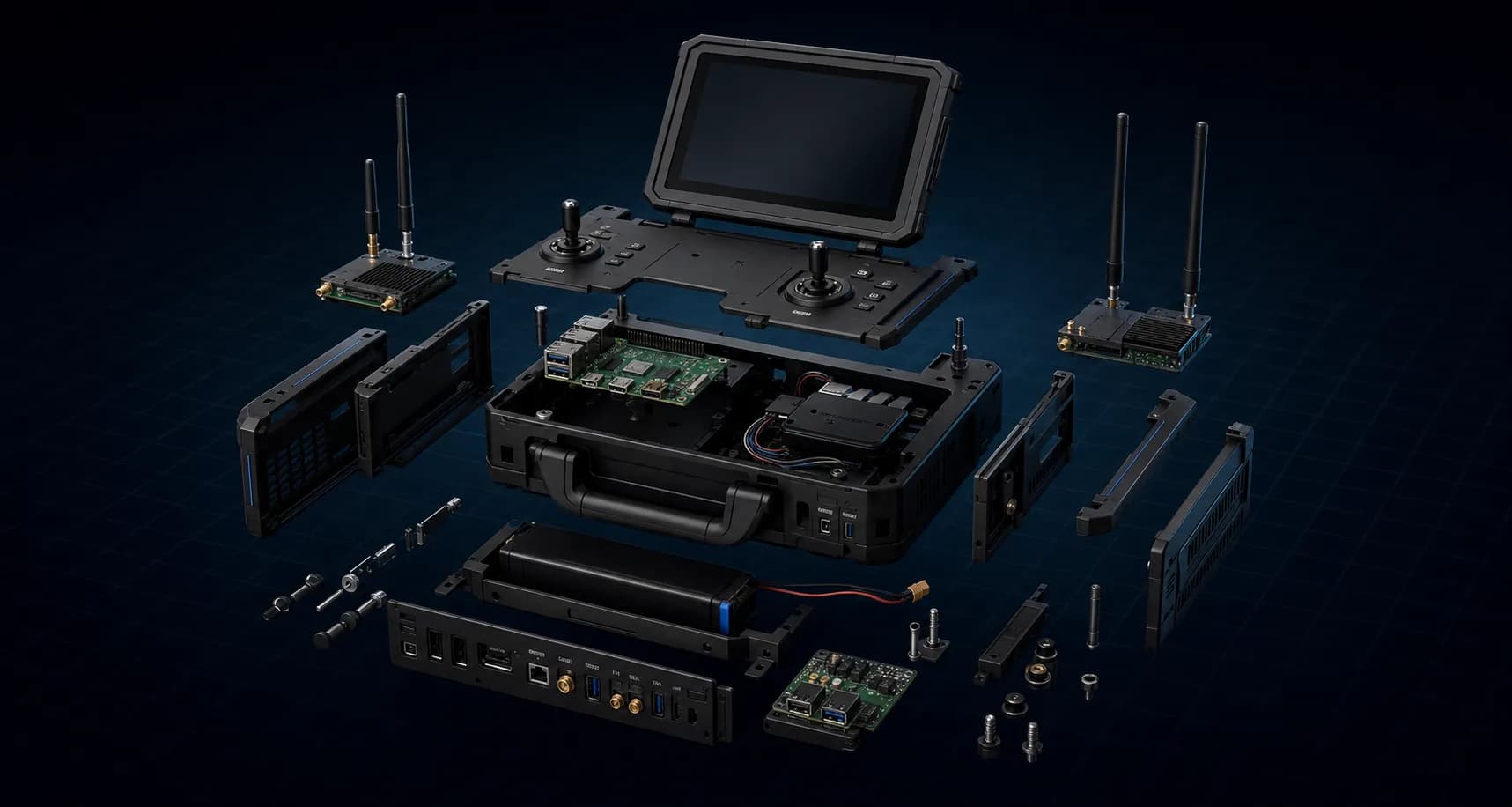
A drone ground control system is the operator's primary interface to mission planning and live vehicle supervision. It may create routes, upload missions, monitor telemetry, receive video, manage payload tasks, present alerts, and offer pause, return, landing, or manual intervention. Its quality is measured by decision clarity, not by the number of widgets on screen.
For autonomous operations, ground control must represent both the autopilot and the higher-level mission system. The operator needs to know the active flight mode, current mission stage, vehicle health, communication age, autonomy state, sensor status, and reason for important decisions without searching across unrelated panels.
Architecture flow
The following simplified flow shows where information is interpreted and where flight-safe execution remains separated. Actual interfaces, rates, redundancy, and authority depend on the aircraft and mission.
What drone ground control system means in practice
A drone ground control system connects mission preparation, aircraft communication, operational supervision, evidence, and intervention. It turns route geometry and payload objectives into a reviewed mission package and gives the operator an observable command path throughout execution.
01 — Mission planner
creates waypoints, areas, altitude, coverage, stages, payload actions, and recovery For drone ground control system, verify this against the aircraft, mission objective, compute budget, sensors, communication link, and flight-safety boundary.
02 — Telemetry client
receives vehicle state, parameters, health, progress, and command acknowledgements For drone ground control system, verify this against the aircraft, mission objective, compute budget, sensors, communication link, and flight-safety boundary.
03 — Video and evidence
displays live imagery and connects recordings or detections to mission time and location For drone ground control system, verify this against the aircraft, mission objective, compute budget, sensors, communication link, and flight-safety boundary.
04 — Operator controls
provide authorized arm, launch, pause, resume, RTL, landing, and override workflows For drone ground control system, verify this against the aircraft, mission objective, compute budget, sensors, communication link, and flight-safety boundary.
Architecture and component responsibilities
A useful architecture assigns each component a narrow responsibility and makes every authority transition visible. For drone ground control system, system quality depends less on one device than on how data, commands, acknowledgements, and failures move between components.
01 — Vehicle link
telemetry radios or networks require measured range, rate, latency, loss, and reconnection behavior For drone ground control system, verify this against message ownership, update rate, latency, stale-data handling, command acknowledgement, and operator authority.
02 — Mission protocol
upload and download need sequence validation, acknowledgement, and version awareness For drone ground control system, verify this against message ownership, update rate, latency, stale-data handling, command acknowledgement, and operator authority.
03 — Video link
bitrate, latency, receiver state, recording, and loss need independent visibility For drone ground control system, verify this against message ownership, update rate, latency, stale-data handling, command acknowledgement, and operator authority.
04 — Onboard AI link
decision state, sensor health, confidence, alerts, and requested actions should be explainable For drone ground control system, verify this against message ownership, update rate, latency, stale-data handling, command acknowledgement, and operator authority.
End-to-end operating workflow
The workflow should describe the system from mission preparation through execution and recovery. The sequence below is deliberately operational: it connects software behavior with checks that an engineering team and an operator can observe.
01 — Create
define the mission objective, route, boundaries, altitude, payload actions, and recovery plan For drone ground control system, verify this against mission state, pre-flight readiness, environmental conditions, flight mode, telemetry freshness, and the defined recovery path.
02 — Review
preview the route in context and check geofence, terrain, energy, communications, and site constraints For drone ground control system, verify this against mission state, pre-flight readiness, environmental conditions, flight mode, telemetry freshness, and the defined recovery path.
03 — Authorize
confirm vehicle, crew, mission version, readiness, and operating permission before launch For drone ground control system, verify this against mission state, pre-flight readiness, environmental conditions, flight mode, telemetry freshness, and the defined recovery path.
04 — Supervise
monitor execution and retain clear intervention controls and evidence throughout the mission For drone ground control system, verify this against mission state, pre-flight readiness, environmental conditions, flight mode, telemetry freshness, and the defined recovery path.
Engineering design considerations
A technically credible system is built around constraints rather than ideal demonstrations. These considerations shape hardware selection, software boundaries, test coverage, and the conditions under which the capability should or should not be enabled.
01 — Information hierarchy
urgent safety state must be more visible than configuration detail For drone ground control system, verify this against power, mass, thermal limits, vibration, electromagnetic compatibility, timing, maintainability, and safe degradation.
02 — Command feedback
every action needs pending, accepted, rejected, completed, or failed status For drone ground control system, verify this against power, mass, thermal limits, vibration, electromagnetic compatibility, timing, maintainability, and safe degradation.
03 — Offline behavior
maps, plans, logs, and core controls should account for limited field connectivity For drone ground control system, verify this against power, mass, thermal limits, vibration, electromagnetic compatibility, timing, maintainability, and safe degradation.
04 — Human factors
labels, alerts, colors, touch targets, and confirmation steps need field evaluation For drone ground control system, verify this against power, mass, thermal limits, vibration, electromagnetic compatibility, timing, maintainability, and safe degradation.
Limitations and failure modes
No autonomy or sensing capability should be presented as certain in every environment. Identifying limitations early prevents a promising prototype from becoming an unsafe or unreliable field workflow.
01 — Link dependency
ground control cannot assume uninterrupted telemetry or video For drone ground control system, verify this against sensor uncertainty, occlusion, weather, range, vehicle dynamics, communications, human factors, and regulatory operating limits.
02 — Map uncertainty
basemaps, elevation, obstacles, and site changes may be incomplete or outdated For drone ground control system, verify this against sensor uncertainty, occlusion, weather, range, vehicle dynamics, communications, human factors, and regulatory operating limits.
03 — Alert overload
excessive low-value notifications can hide a time-critical failure For drone ground control system, verify this against sensor uncertainty, occlusion, weather, range, vehicle dynamics, communications, human factors, and regulatory operating limits.
04 — Configuration mismatch
the interface may show capabilities the connected vehicle or firmware does not support For drone ground control system, verify this against sensor uncertainty, occlusion, weather, range, vehicle dynamics, communications, human factors, and regulatory operating limits.
Verification before flight
Verification should progress from repeatable software tests to integrated hardware and controlled flight. Passing a nominal demonstration is only one result; the team must also test missing, delayed, contradictory, and out-of-range inputs.
01 — Mission validation
test invalid coordinates, altitude, sequence, geofence, unsupported commands, and incomplete plans For drone ground control system, verify this against acceptance criteria, traceable logs, repeatability, safe abort behavior, manual override, and evidence that each fallback occurs within its allowed time.
02 — Link testing
introduce delay, loss, low bandwidth, disconnection, and reconnect during each mission state For drone ground control system, verify this against acceptance criteria, traceable logs, repeatability, safe abort behavior, manual override, and evidence that each fallback occurs within its allowed time.
03 — Usability trials
measure whether trained operators can recognize failures and execute overrides under workload For drone ground control system, verify this against acceptance criteria, traceable logs, repeatability, safe abort behavior, manual override, and evidence that each fallback occurs within its allowed time.
04 — Field acceptance
verify hardware endurance, battery, sunlight readability, controls, radios, storage, and logs For drone ground control system, verify this against acceptance criteria, traceable logs, repeatability, safe abort behavior, manual override, and evidence that each fallback occurs within its allowed time.
Deployment and operator supervision
Field deployment combines the technical system with procedures, permissions, training, maintenance, and review. Human supervision is most effective when the interface explains what the aircraft is doing, why it is doing it, and which intervention remains available.
01 — Pre-flight workflow
guide rather than replace aircraft, airspace, weather, site, and crew checks For drone ground control system, verify this against site authorization, checklists, crew roles, data handling, maintenance intervals, incident review, and change control.
02 — Role control
define which users may edit plans, authorize launch, command the aircraft, or access evidence For drone ground control system, verify this against site authorization, checklists, crew roles, data handling, maintenance intervals, incident review, and change control.
03 — Mission record
preserve plan version, operator actions, commands, telemetry, detections, and outcome For drone ground control system, verify this against site authorization, checklists, crew roles, data handling, maintenance intervals, incident review, and change control.
04 — Training
practice nominal missions and degraded operations, including telemetry loss, video loss, and RTL For drone ground control system, verify this against site authorization, checklists, crew roles, data handling, maintenance intervals, incident review, and change control.
Frequently asked questions
These concise answers summarize common engineering questions. They do not replace the selected hardware documentation, flight testing, operating approval, or a mission-specific safety assessment.
What does a drone ground control system manage?
It manages mission planning, communication, telemetry, video, payload workflow, status, logs, and operator commands.
Why use a 3D mission preview?
It helps operators review route and altitude geometry in context before takeoff.
Can missions be saved and repeated?
Yes, when plans are versioned and revalidated for the current site, vehicle, and conditions.
Should video and telemetry share one link?
They can, but bandwidth competition and independent failure visibility must be engineered.
What happens if ground control disconnects?
The aircraft should follow a predefined autopilot and mission response appropriate to the operation.
Continue with Aeroniti engineering resources
Explore the related product and solution architecture, or bring Aeroniti a specific aircraft, sensor, payload, mission, and operating constraint for a focused technical discussion.