Jetson Orin Nano · Drone AI · Companion Computers
Jetson Orin Nano for Drone AI
By Aeroniti Engineering · Published 2026-07-19 · Updated 2026-07-19
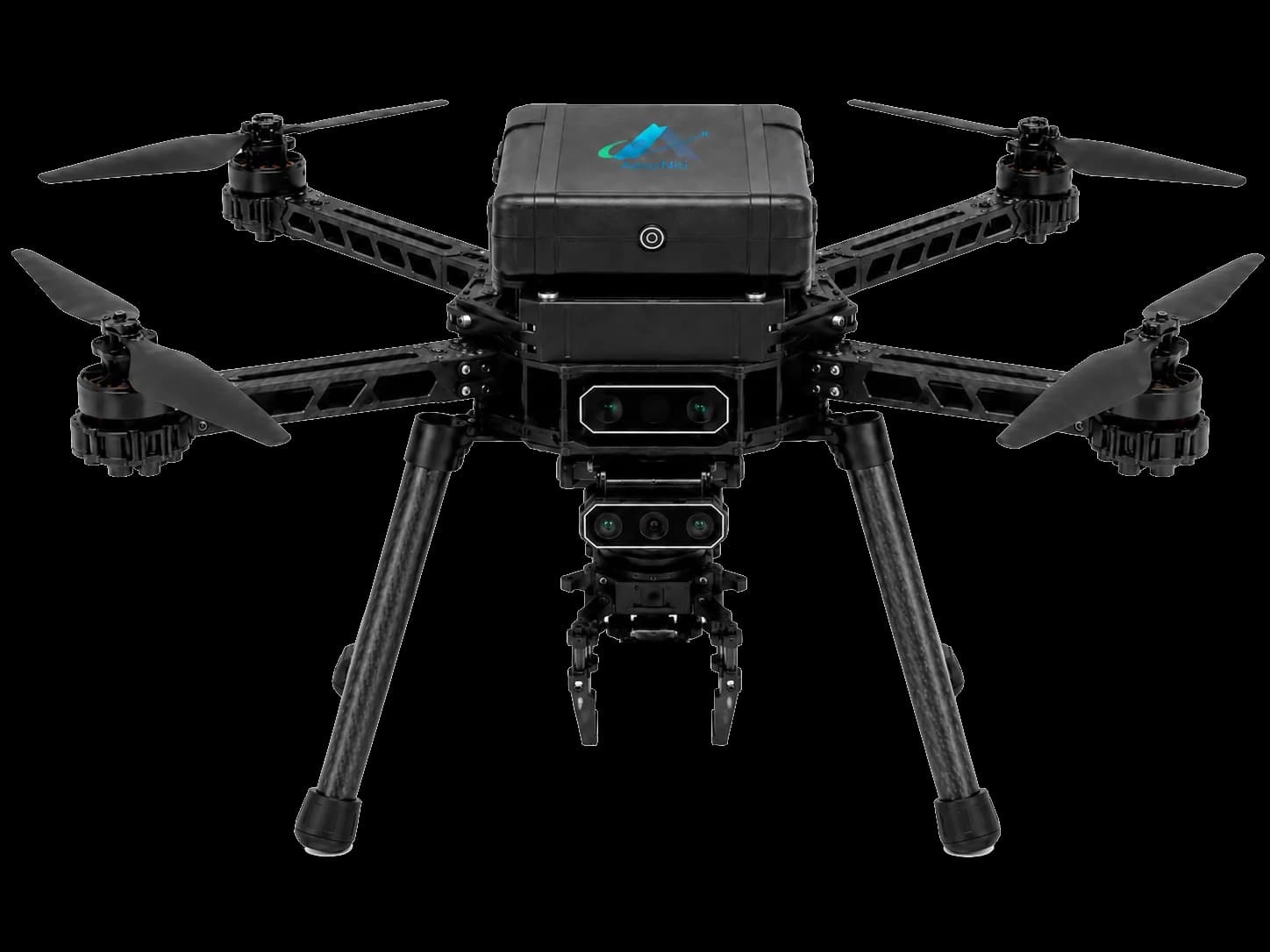
Jetson Orin Nano gives a drone access to GPU-accelerated computing for vision models, depth processing, sensor fusion, mapping, and high-level mission logic. Its value is not simply benchmark performance. A useful airborne integration must deliver inference results with known timing while fitting the aircraft's mass, power, cooling, storage, and communication limits.
The Jetson should operate as a companion computer, not a flight-controller replacement. It can interpret camera, depth, thermal, or LiDAR data and request a mission action through MAVLink. Pixhawk and ArduPilot continue to stabilize the aircraft, control motors, manage flight modes, and enforce configured safety behavior.
Architecture flow
The following simplified flow shows where information is interpreted and where flight-safe execution remains separated. Actual interfaces, rates, redundancy, and authority depend on the aircraft and mission.
What Jetson Orin Nano drone AI means in practice
Jetson Orin Nano drone AI is an onboard compute architecture that brings model inference and sensor processing onto the aircraft. It reduces dependence on streaming every raw input to the ground, but it also introduces power, heat, startup, software, and failure considerations that must be designed into the vehicle.
01 — Compute module
runs CUDA-enabled inference, application services, sensor processing, and mission logic For Jetson Orin Nano drone AI, verify this against the aircraft, mission objective, compute budget, sensors, communication link, and flight-safety boundary.
02 — Carrier and power
provide regulated input, robust connectors, required interfaces, and transient margin For Jetson Orin Nano drone AI, verify this against the aircraft, mission objective, compute budget, sensors, communication link, and flight-safety boundary.
03 — Sensor set
supplies RGB, depth, thermal, LiDAR, or payload data with calibrated time and geometry For Jetson Orin Nano drone AI, verify this against the aircraft, mission objective, compute budget, sensors, communication link, and flight-safety boundary.
04 — Autopilot link
exchanges vehicle state and bounded command intent with Pixhawk through MAVLink For Jetson Orin Nano drone AI, verify this against the aircraft, mission objective, compute budget, sensors, communication link, and flight-safety boundary.
Architecture and component responsibilities
A useful architecture assigns each component a narrow responsibility and makes every authority transition visible. For Jetson Orin Nano drone AI, system quality depends less on one device than on how data, commands, acknowledgements, and failures move between components.
01 — Camera transport
CSI, USB, or network cameras require bandwidth, drivers, timestamps, and recovery behavior For Jetson Orin Nano drone AI, verify this against message ownership, update rate, latency, stale-data handling, command acknowledgement, and operator authority.
02 — Range sensors
depth and LiDAR need coordinate frames, calibration, filtering, and freshness thresholds For Jetson Orin Nano drone AI, verify this against message ownership, update rate, latency, stale-data handling, command acknowledgement, and operator authority.
03 — MAVLink telemetry
vehicle pose, mode, battery, mission state, and command acknowledgement must be verified For Jetson Orin Nano drone AI, verify this against message ownership, update rate, latency, stale-data handling, command acknowledgement, and operator authority.
04 — Storage and network
logs, models, updates, evidence, and remote access need capacity and access controls For Jetson Orin Nano drone AI, verify this against message ownership, update rate, latency, stale-data handling, command acknowledgement, and operator authority.
End-to-end operating workflow
The workflow should describe the system from mission preparation through execution and recovery. The sequence below is deliberately operational: it connects software behavior with checks that an engineering team and an operator can observe.
01 — Acquire
timestamp sensor frames and confirm calibration, exposure, range, and data health For Jetson Orin Nano drone AI, verify this against mission state, pre-flight readiness, environmental conditions, flight mode, telemetry freshness, and the defined recovery path.
02 — Infer
preprocess inputs, run optimized models, and measure end-to-end rather than model-only latency For Jetson Orin Nano drone AI, verify this against mission state, pre-flight readiness, environmental conditions, flight mode, telemetry freshness, and the defined recovery path.
03 — Decide
combine confidence, freshness, mission state, and safety constraints before requesting an action For Jetson Orin Nano drone AI, verify this against mission state, pre-flight readiness, environmental conditions, flight mode, telemetry freshness, and the defined recovery path.
04 — Report
return detections, system health, evidence, and decision state for operator supervision For Jetson Orin Nano drone AI, verify this against mission state, pre-flight readiness, environmental conditions, flight mode, telemetry freshness, and the defined recovery path.
Engineering design considerations
A technically credible system is built around constraints rather than ideal demonstrations. These considerations shape hardware selection, software boundaries, test coverage, and the conditions under which the capability should or should not be enabled.
01 — Power budget
measure average, peak, startup, peripheral, storage, and cooling demand under representative load For Jetson Orin Nano drone AI, verify this against power, mass, thermal limits, vibration, electromagnetic compatibility, timing, maintainability, and safe degradation.
02 — Thermal path
design airflow or conduction for the enclosure, ambient temperature, solar load, and flight profile For Jetson Orin Nano drone AI, verify this against power, mass, thermal limits, vibration, electromagnetic compatibility, timing, maintainability, and safe degradation.
03 — Software lifecycle
pin drivers, runtime, model, OS, and application versions with reproducible deployment For Jetson Orin Nano drone AI, verify this against power, mass, thermal limits, vibration, electromagnetic compatibility, timing, maintainability, and safe degradation.
04 — Real-time expectations
isolate critical application paths and monitor dropped frames, queues, stalls, and restart time For Jetson Orin Nano drone AI, verify this against power, mass, thermal limits, vibration, electromagnetic compatibility, timing, maintainability, and safe degradation.
Limitations and failure modes
No autonomy or sensing capability should be presented as certain in every environment. Identifying limitations early prevents a promising prototype from becoming an unsafe or unreliable field workflow.
01 — Thermal throttling
compute performance can fall as temperature rises inside an enclosed aircraft For Jetson Orin Nano drone AI, verify this against sensor uncertainty, occlusion, weather, range, vehicle dynamics, communications, human factors, and regulatory operating limits.
02 — Model uncertainty
benchmark accuracy does not guarantee performance on mission imagery, angles, motion, or weather For Jetson Orin Nano drone AI, verify this against sensor uncertainty, occlusion, weather, range, vehicle dynamics, communications, human factors, and regulatory operating limits.
03 — Peripheral instability
cameras and USB devices can disconnect or enumerate differently after restart For Jetson Orin Nano drone AI, verify this against sensor uncertainty, occlusion, weather, range, vehicle dynamics, communications, human factors, and regulatory operating limits.
04 — Boot dependency
autonomy may be unavailable for part of startup, so the flight plan needs a defined readiness gate For Jetson Orin Nano drone AI, verify this against sensor uncertainty, occlusion, weather, range, vehicle dynamics, communications, human factors, and regulatory operating limits.
Verification before flight
Verification should progress from repeatable software tests to integrated hardware and controlled flight. Passing a nominal demonstration is only one result; the team must also test missing, delayed, contradictory, and out-of-range inputs.
01 — Dataset evaluation
test mission-representative imagery and report precision, recall, confidence, and failure cases For Jetson Orin Nano drone AI, verify this against acceptance criteria, traceable logs, repeatability, safe abort behavior, manual override, and evidence that each fallback occurs within its allowed time.
02 — Load test
run sensors, inference, recording, networking, and telemetry together at temperature For Jetson Orin Nano drone AI, verify this against acceptance criteria, traceable logs, repeatability, safe abort behavior, manual override, and evidence that each fallback occurs within its allowed time.
03 — Restart test
verify service recovery, device discovery, time synchronization, and safe autopilot behavior For Jetson Orin Nano drone AI, verify this against acceptance criteria, traceable logs, repeatability, safe abort behavior, manual override, and evidence that each fallback occurs within its allowed time.
04 — Flight test
measure latency, thermal state, power, vibration effects, link health, and operator visibility For Jetson Orin Nano drone AI, verify this against acceptance criteria, traceable logs, repeatability, safe abort behavior, manual override, and evidence that each fallback occurs within its allowed time.
Deployment and operator supervision
Field deployment combines the technical system with procedures, permissions, training, maintenance, and review. Human supervision is most effective when the interface explains what the aircraft is doing, why it is doing it, and which intervention remains available.
01 — Readiness state
do not enable AI-dependent mission stages until sensors, models, time, and telemetry are healthy For Jetson Orin Nano drone AI, verify this against site authorization, checklists, crew roles, data handling, maintenance intervals, incident review, and change control.
02 — Remote diagnostics
expose useful health information without opening unnecessary command surfaces For Jetson Orin Nano drone AI, verify this against site authorization, checklists, crew roles, data handling, maintenance intervals, incident review, and change control.
03 — Evidence retention
define what imagery and inference metadata are stored, transferred, protected, and deleted For Jetson Orin Nano drone AI, verify this against site authorization, checklists, crew roles, data handling, maintenance intervals, incident review, and change control.
04 — Update control
revalidate performance and safety after model, driver, OS, sensor, or enclosure changes For Jetson Orin Nano drone AI, verify this against site authorization, checklists, crew roles, data handling, maintenance intervals, incident review, and change control.
Frequently asked questions
These concise answers summarize common engineering questions. They do not replace the selected hardware documentation, flight testing, operating approval, or a mission-specific safety assessment.
Can Jetson Orin Nano control a drone?
It can request high-level actions as a companion computer, while Pixhawk and ArduPilot should retain flight control.
Can it run YOLO models?
Yes, with performance depending on model size, optimization, resolution, frame rate, thermal design, and other workloads.
Which sensors can connect?
Compatible RGB, depth, thermal, LiDAR, and other sensors can be integrated through supported interfaces.
Does onboard AI work without an internet connection?
Local inference can work without internet, although telemetry, map, update, or remote services may have separate connectivity needs.
What is the biggest integration risk?
Treating compute benchmarks as system performance without testing power, heat, latency, sensors, failures, and flight conditions.
Continue with Aeroniti engineering resources
Explore the related product and solution architecture, or bring Aeroniti a specific aircraft, sensor, payload, mission, and operating constraint for a focused technical discussion.