Thermal Imaging · Surveillance · AI Detection
Thermal Camera Drone Surveillance
By Aeroniti Engineering · Published 2026-07-19 · Updated 2026-07-19
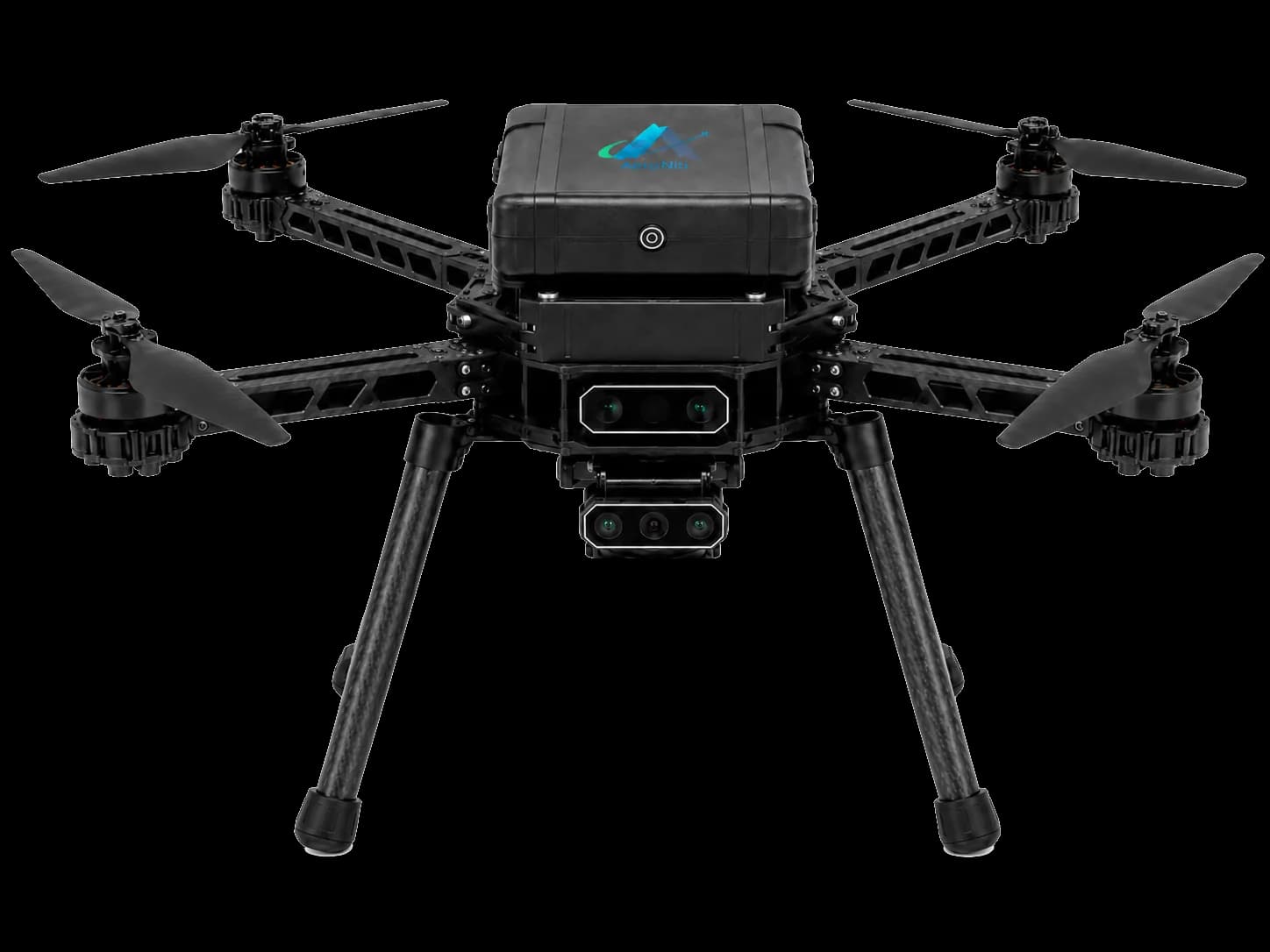
Thermal cameras form images from infrared energy rather than visible light. They can reveal temperature contrast at night and may assist observation where RGB imagery is limited. They do not see identity, intent, or every object with certainty. Useful interpretation depends on sensor resolution, lens, range, contrast, weather, viewing angle, calibration, and operator context.
A thermal surveillance drone combines more than a camera. It needs a planned and authorized patrol, stable gimbal or mounting, onboard or ground processing, location-aware detections, telemetry, evidence capture, alerts, and an operator workflow for reviewing possible humans, animals, intruders, or heat anomalies.
Architecture flow
The following simplified flow shows where information is interpreted and where flight-safe execution remains separated. Actual interfaces, rates, redundancy, and authority depend on the aircraft and mission.
What thermal surveillance drone means in practice
A thermal surveillance drone is a supervised aerial sensing system that connects thermal imagery with mission routes, aircraft state, optional RGB context, detection models, alerts, and evidence. It supports operator awareness; it should not turn uncertain heat signatures into unexplained autonomous conclusions.
01 — Thermal camera
provides radiometric or non-radiometric infrared imagery with a selected lens and resolution For thermal surveillance drone, verify this against the aircraft, mission objective, compute budget, sensors, communication link, and flight-safety boundary.
02 — RGB camera
adds visible context, scene detail, and a second source for operator review where light allows For thermal surveillance drone, verify this against the aircraft, mission objective, compute budget, sensors, communication link, and flight-safety boundary.
03 — Onboard compute
runs image conditioning, detection, tracking, geolocation support, and event logic For thermal surveillance drone, verify this against the aircraft, mission objective, compute budget, sensors, communication link, and flight-safety boundary.
04 — Mission system
plans patrol routes and returns video, telemetry, detections, and intervention controls For thermal surveillance drone, verify this against the aircraft, mission objective, compute budget, sensors, communication link, and flight-safety boundary.
Architecture and component responsibilities
A useful architecture assigns each component a narrow responsibility and makes every authority transition visible. For thermal surveillance drone, system quality depends less on one device than on how data, commands, acknowledgements, and failures move between components.
01 — Video transport
thermal streams require compatible encoding, timestamps, bandwidth, and recovery For thermal surveillance drone, verify this against message ownership, update rate, latency, stale-data handling, command acknowledgement, and operator authority.
02 — Camera metadata
calibration, lens, temperature range, palettes, and radiometric properties affect interpretation For thermal surveillance drone, verify this against message ownership, update rate, latency, stale-data handling, command acknowledgement, and operator authority.
03 — Location context
detections need synchronized vehicle pose and camera orientation to support useful mapping For thermal surveillance drone, verify this against message ownership, update rate, latency, stale-data handling, command acknowledgement, and operator authority.
04 — Alert path
events should carry confidence, imagery, time, location, and review state rather than only a label For thermal surveillance drone, verify this against message ownership, update rate, latency, stale-data handling, command acknowledgement, and operator authority.
End-to-end operating workflow
The workflow should describe the system from mission preparation through execution and recovery. The sequence below is deliberately operational: it connects software behavior with checks that an engineering team and an operator can observe.
01 — Plan
define perimeter, altitude, viewing geometry, revisit rate, privacy limits, and response procedure For thermal surveillance drone, verify this against mission state, pre-flight readiness, environmental conditions, flight mode, telemetry freshness, and the defined recovery path.
02 — Capture
stabilize imagery and monitor focus, contrast, frame rate, sensor health, and environmental effects For thermal surveillance drone, verify this against mission state, pre-flight readiness, environmental conditions, flight mode, telemetry freshness, and the defined recovery path.
03 — Detect
evaluate thermal patterns with model confidence, tracking, temporal consistency, and optional RGB evidence For thermal surveillance drone, verify this against mission state, pre-flight readiness, environmental conditions, flight mode, telemetry freshness, and the defined recovery path.
04 — Review
present the operator with source imagery and context before escalation or mission changes For thermal surveillance drone, verify this against mission state, pre-flight readiness, environmental conditions, flight mode, telemetry freshness, and the defined recovery path.
Engineering design considerations
A technically credible system is built around constraints rather than ideal demonstrations. These considerations shape hardware selection, software boundaries, test coverage, and the conditions under which the capability should or should not be enabled.
01 — Ground sampling
target size in pixels matters more than nominal camera resolution alone For thermal surveillance drone, verify this against power, mass, thermal limits, vibration, electromagnetic compatibility, timing, maintainability, and safe degradation.
02 — Lens selection
a narrow field of view increases detail but reduces coverage and demands more accurate pointing For thermal surveillance drone, verify this against power, mass, thermal limits, vibration, electromagnetic compatibility, timing, maintainability, and safe degradation.
03 — False alerts
machinery, roofs, animals, reflections, exhaust, and warm surfaces can resemble target signatures For thermal surveillance drone, verify this against power, mass, thermal limits, vibration, electromagnetic compatibility, timing, maintainability, and safe degradation.
04 — Privacy and access
patrol design, recording, retention, and operator permissions need documented controls For thermal surveillance drone, verify this against power, mass, thermal limits, vibration, electromagnetic compatibility, timing, maintainability, and safe degradation.
Limitations and failure modes
No autonomy or sensing capability should be presented as certain in every environment. Identifying limitations early prevents a promising prototype from becoming an unsafe or unreliable field workflow.
01 — Thermal crossover
objects and surroundings can approach similar temperatures and lose useful contrast For thermal surveillance drone, verify this against sensor uncertainty, occlusion, weather, range, vehicle dynamics, communications, human factors, and regulatory operating limits.
02 — Occlusion
vegetation, structures, terrain, and most solid barriers can hide heat sources For thermal surveillance drone, verify this against sensor uncertainty, occlusion, weather, range, vehicle dynamics, communications, human factors, and regulatory operating limits.
03 — Atmosphere and range
humidity, rain, fog, smoke density, and distance can reduce usable detail For thermal surveillance drone, verify this against sensor uncertainty, occlusion, weather, range, vehicle dynamics, communications, human factors, and regulatory operating limits.
04 — Classification uncertainty
a heat blob may not contain enough information for reliable identity or intent For thermal surveillance drone, verify this against sensor uncertainty, occlusion, weather, range, vehicle dynamics, communications, human factors, and regulatory operating limits.
Verification before flight
Verification should progress from repeatable software tests to integrated hardware and controlled flight. Passing a nominal demonstration is only one result; the team must also test missing, delayed, contradictory, and out-of-range inputs.
01 — Scenario dataset
collect representative day, night, season, target, background, range, and viewing-angle examples For thermal surveillance drone, verify this against acceptance criteria, traceable logs, repeatability, safe abort behavior, manual override, and evidence that each fallback occurs within its allowed time.
02 — Detection analysis
report missed targets and false alerts instead of relying only on selected demonstrations For thermal surveillance drone, verify this against acceptance criteria, traceable logs, repeatability, safe abort behavior, manual override, and evidence that each fallback occurs within its allowed time.
03 — Patrol test
verify coverage, revisit time, geolocation usefulness, link quality, and operator workload For thermal surveillance drone, verify this against acceptance criteria, traceable logs, repeatability, safe abort behavior, manual override, and evidence that each fallback occurs within its allowed time.
04 — Failure test
evaluate camera loss, obscured lens, low contrast, model stall, link loss, and safe mission recovery For thermal surveillance drone, verify this against acceptance criteria, traceable logs, repeatability, safe abort behavior, manual override, and evidence that each fallback occurs within its allowed time.
Deployment and operator supervision
Field deployment combines the technical system with procedures, permissions, training, maintenance, and review. Human supervision is most effective when the interface explains what the aircraft is doing, why it is doing it, and which intervention remains available.
01 — Mission briefing
define what operators are looking for and which findings require confirmation For thermal surveillance drone, verify this against site authorization, checklists, crew roles, data handling, maintenance intervals, incident review, and change control.
02 — Human review
preserve access to raw thermal and RGB evidence for every important alert For thermal surveillance drone, verify this against site authorization, checklists, crew roles, data handling, maintenance intervals, incident review, and change control.
03 — Equipment checks
inspect lens, mount, calibration state, storage, compute, video, telemetry, and battery For thermal surveillance drone, verify this against site authorization, checklists, crew roles, data handling, maintenance intervals, incident review, and change control.
04 — Responsible retention
store only necessary mission evidence with appropriate access and deletion practices For thermal surveillance drone, verify this against site authorization, checklists, crew roles, data handling, maintenance intervals, incident review, and change control.
Frequently asked questions
These concise answers summarize common engineering questions. They do not replace the selected hardware documentation, flight testing, operating approval, or a mission-specific safety assessment.
Can a thermal drone see in complete darkness?
It can form images from heat contrast without visible light, subject to sensor and environmental limits.
Can thermal cameras see through walls?
No. Most solid structures block the thermal radiation needed to image what is behind them.
Can AI identify every person?
No. Thermal detections are uncertain and should be reviewed with context by an operator.
Does thermal imaging work through smoke?
It may help in some conditions, but smoke density, range, temperature contrast, and sensor properties matter.
Is thermal surveillance fully autonomous?
Mission routes and detection can be automated, but operator supervision and authorized response remain important.
Continue with Aeroniti engineering resources
Explore the related product and solution architecture, or bring Aeroniti a specific aircraft, sensor, payload, mission, and operating constraint for a focused technical discussion.